
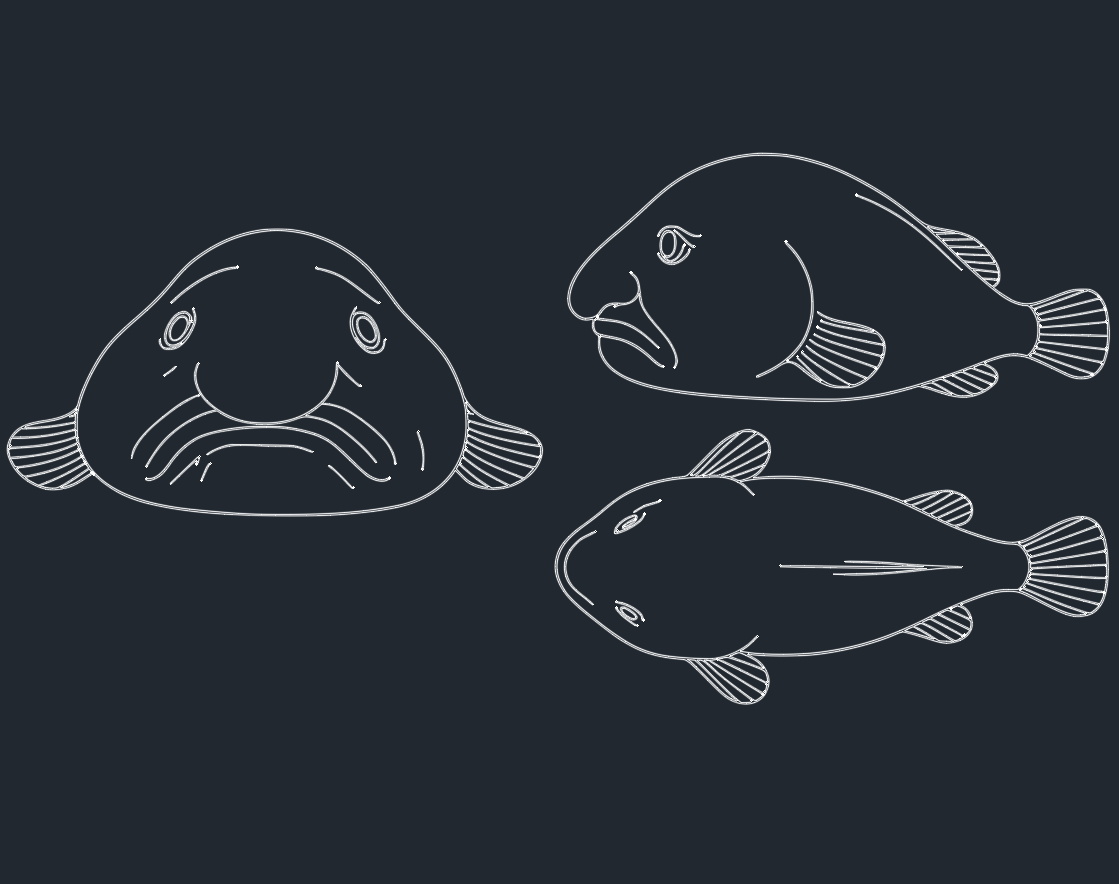
Introduction to Blob Fish in CAD Design
The term blob fish may initially evoke images of the deep-sea marine creature renowned for its gelatinous appearance. However, in the context of AutoCAD and DWG libraries, “blob fish” can refer to both the visual nature of organic, freeform shapes and the technical challenges of managing complex, non-standard geometries in CAD workflows. For engineers, CAD designers, and architects, understanding how to efficiently model, store, and manipulate such forms is crucial for advanced design projects.
What is a Blob Fish Shape in CAD?
The blob fish shape in CAD typically describes irregular, amorphous, or soft-edged geometry that departs from traditional parametric or prismatic forms. These shapes are common in architectural biomimicry, ergonomic product design, and certain civil engineering applications, such as landscape modeling or organic façade systems.
Key characteristics of blob fish shapes in CAD:
– Non-linear, irregular geometry
– Soft, flowing curves and surfaces
– Complex meshes or splines
– Challenging to define with standard CAD primitives
Importance of Blob Fish Forms in Modern Design
With the rise of parametric modeling and algorithmic design tools, blob fish forms are increasingly prevalent in innovative architecture and engineering. These organic shapes are often inspired by the efficiency of natural systems, leading to optimized structures with reduced material use and enhanced performance.
Applications include:
– Organic facades and building envelopes
– Furniture and interior design
– Product ergonomics
– Landscape architecture
Modeling Blob Fish Geometry in AutoCAD
Modeling blob fish shapes in AutoCAD or similar CAD software requires advanced techniques:
1. NURBS and Splines
Non-Uniform Rational B-Splines (NURBS) and spline curves are fundamental for creating the smooth, continuous surfaces characteristic of blob fish geometry. CAD designers often use the SPLINE and LOFT commands in AutoCAD to achieve these forms.
2. Mesh and Surface Modeling
Mesh modeling allows for greater flexibility in shaping and editing blob fish forms. AutoCAD supports mesh primitives that can be manipulated with tools like SMOOTHMORE and MESHEDIT, enabling the creation of fluid, undulating surfaces.
3. Importing from Parametric Tools
Advanced blob fish forms may be designed using parametric software like Rhino or Grasshopper, then imported into AutoCAD as DWG or DXF files. Maintaining clean topology during import is critical for downstream editing and rendering.
Managing Blob Fish DWG Files in Libraries
Storing and organizing blob fish DWG files in libraries presents unique challenges:
– File Size: Blob fish geometries often result in large DWG files due to complex surface data.
– Layer Management: Efficient use of layers and blocks helps streamline editing and collaboration.
– Metadata Tagging: Properly tagging files with keywords like “blob fish,” “organic,” and “freeform” enhances searchability for engineers and architects.
Best Practices:
– Use external references (Xrefs) for modularity.
– Regularly purge unused data to minimize file size.
– Standardize naming conventions for easy retrieval.
Rendering and Visualization of Blob Fish Forms
Accurate visualization of blob fish shapes is essential for communication with stakeholders and clients. AutoCAD supports high-quality rendering and shading, but for photorealistic visualization, exporting to specialized rendering tools like 3ds Max or Lumion is recommended. Applying realistic materials and lighting helps convey the soft, organic qualities typical of blob fish geometry.
Download Free Blob Fish DWG Blocks
Many online DWG libraries now offer ready-to-use blob fish blocks and templates for AutoCAD. These resources can accelerate the modeling process and ensure consistency in organic design elements. When downloading blob fish DWG files, ensure they are compatible with your CAD version and meet your project’s technical requirements.
Conclusion
The blob fish concept in CAD and DWG libraries encapsulates the trend toward organic, freeform design in engineering and architecture. Mastery of blob fish modeling techniques enhances creativity and technical proficiency, allowing professionals to push the boundaries of digital design. For engineers, CAD designers, and architects seeking to incorporate blob fish shapes, leveraging advanced CAD tools and well-organized DWG libraries is essential for efficient, high-quality project delivery.
Leave a Reply
You must be logged in to post a comment.