
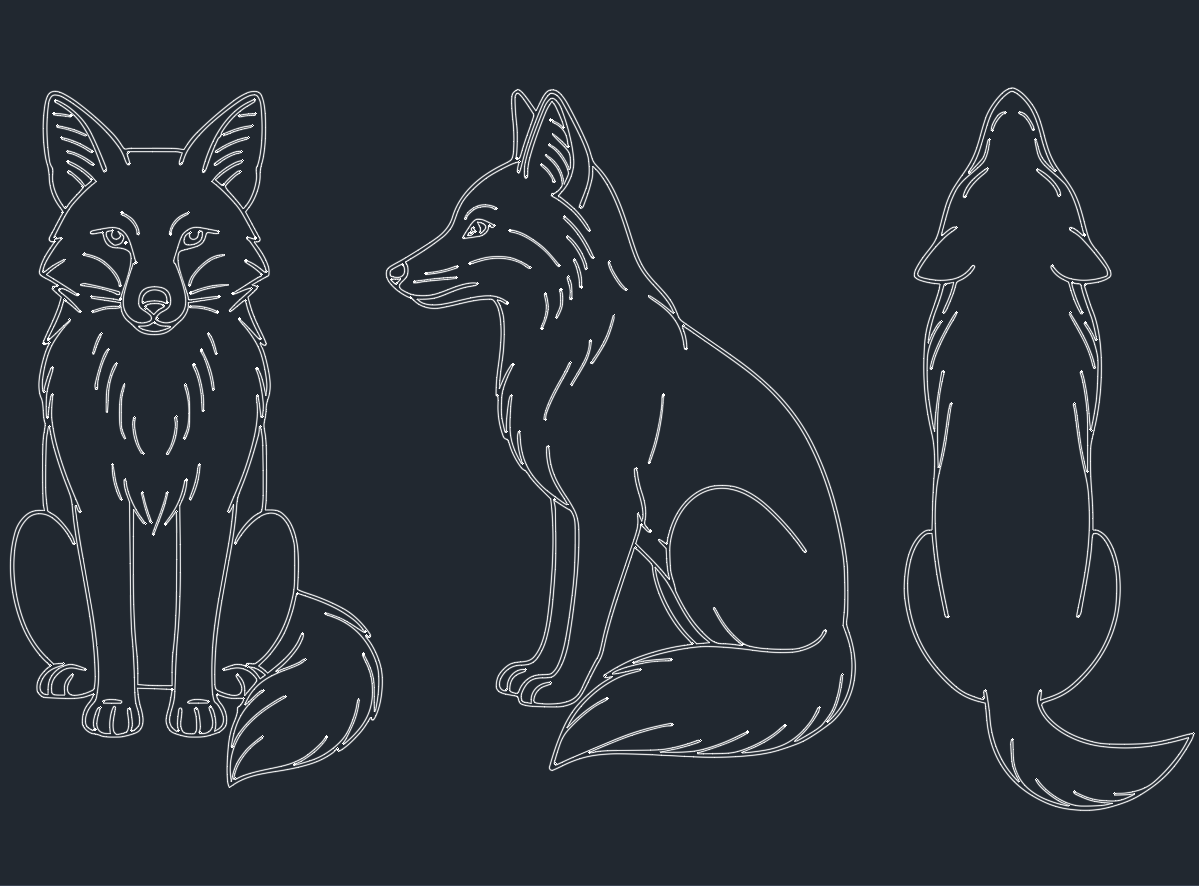
Understanding Foxes: Biological Insights for CAD Design
Foxes, belonging to the Canidae family, are small to medium-sized omnivorous mammals recognized for their agility, adaptability, and distinctive bushy tails. For engineers, CAD designers, and architects working on wildlife habitats, educational exhibits, or landscape integrations, a technical understanding of fox anatomy and behavior is essential for accurate and functional project designs. This post explores the core biological and structural features of foxes, providing valuable reference points for your AutoCAD or DWG library projects.
Key Morphological Features of Foxes
When creating CAD blocks or DWG models of foxes, it is crucial to consider their anatomical details for realistic representation and spatial planning.
– Size and Proportions: Most adult foxes measure 35–50 cm in height at the shoulder and 60–90 cm in body length, with the tail accounting for up to 40 cm. These dimensions can vary by species, such as the Red Fox (*Vulpes vulpes*) or Fennec Fox (*Vulpes zerda*).
– Body Structure: Foxes have slender bodies, pointed snouts, and large, upright ears. Their lightweight frames and agile limbs allow for swift movement, which is important to reflect in dynamic CAD animations or habitat enclosure designs.
– Fur and Coloration: Fox fur varies from reddish-orange to silver, gray, or white, depending on the species and environment. Accurately mapping fur patterns and coloration in your DWG files enhances realism, especially in educational or interpretive designs.
Behavioral Patterns Relevant to CAD Planning
Understanding fox behavior is vital for engineers and architects designing wildlife crossings, urban parks, or zoo habitats:
– Nocturnal Activity: Foxes are primarily nocturnal, requiring CAD-integrated lighting and shelter considerations in designs.
– Territorial Range: Fox territories can span 2–10 square kilometers. When planning wildlife corridors or integrating animal icons in site plans, reflect realistic spatial ranges.
– Burrowing Habits: Foxes dig dens, often in loose soil or under structures. For infrastructure projects, use accurate DWG blocks to model potential burrowing sites and plan preventive measures.
Foxes in Landscape and Urban Design
Foxes are increasingly present in urban areas, which influences site planning and landscape architecture projects. Inclusion of foxes in CAD libraries aids in scenario modeling, biodiversity studies, and public education initiatives.
– Wildlife Corridors: Design wildlife corridors and crossings that accommodate foxes’ movement and safety. Use precise fox DWG blocks for collision analysis and pathway optimization.
– Habitat Integration: In parks and nature reserves, fox habitat features—such as native vegetation and natural cover—should be modeled in AutoCAD to enhance biodiversity and minimize human-wildlife conflict.
Best Practices for Downloading Fox DWG and CAD Blocks
Engineers and designers seeking accurate fox models should prioritize high-quality, scalable DWG files that reflect correct anatomical proportions and behavior. Key considerations include:
– File Compatibility: Ensure fox CAD blocks are compatible with your AutoCAD version and support both 2D and 3D formats for flexibility in presentations and technical documentation.
– Detail Level: Choose DWG files that offer customizable detail levels, from schematic outlines for site plans to detailed 3D models for rendering and visualization.
– Licensing and Attribution: Use only royalty-free or appropriately licensed fox DWG files to comply with project requirements and intellectual property regulations.
Applications of Fox Models in Engineering and Architecture
The use of fox DWG blocks and CAD models extends beyond aesthetics:
– Environmental Impact Assessments: Accurately placed fox models help evaluate the impact of proposed developments on local wildlife.
– Educational Displays: Detailed fox CAD files support the creation of interactive exhibits and educational signage in museums or zoos.
– Thematic Design: Use fox models as thematic elements in parks, recreational spaces, or urban branding initiatives to promote biodiversity awareness.
Conclusion
Foxes, with their distinctive morphology and adaptive behaviors, present unique challenges and opportunities for engineers, CAD designers, and architects. Integrating accurate fox models into your AutoCAD or DWG library enhances the precision, realism, and educational value of your projects. For optimal results, select high-quality, well-documented fox CAD blocks and DWG files that meet your technical and creative needs.
For more resources and downloadable fox CAD files, explore our DWG library and stay updated with the latest wildlife design tools for your engineering and architectural projects.
Leave a Reply
You must be logged in to post a comment.